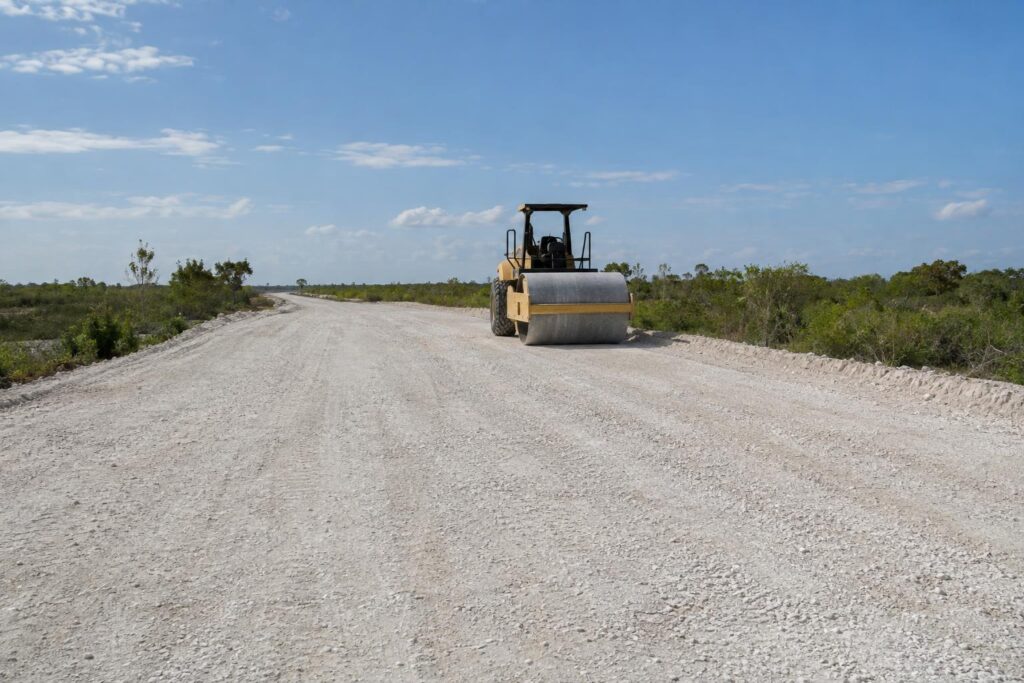
The road base materials on a job do most of their work where nobody can see them. The base course sits between the prepared subgrade and the pavement, and it spreads traffic loads so the surface above doesn’t rut, crack or pump water. In Florida, plans usually name those materials in FDOT’s own vocabulary: limerock, cemented coquina, crushed concrete and graded aggregate. Here’s what each one is, how stabilized subgrade fits underneath, and what compaction testing means for your bid and schedule.
The road base materials Florida plans call for
In FDOT’s Standard Specifications, Section 200 is titled Rock Base, and it begins simply: construct a base composed of base rock. The material rules live in Section 911, and Section 285 (Optional Base Course) lets a set of plans list several acceptable materials for a typical section. When the plans give options, the contractor picks one per typical section and tells the engineer in writing at least 45 calendar days before placing base. That notice period belongs in your schedule.
Limerock
Section 911 defines limerock as unconsolidated or partly consolidated limestone of marine origin. It’s the material most people picture when a Florida plan says “rock base.” FDOT measures its strength with the Limerock Bearing Ratio, or LBR, Florida’s own bearing test. For limerock, the average result per lot must be at least 100, with no individual result below 90, and the carbonate content must be at least 70 percent.
Cemented coquina and other shell-based rock
Cemented coquina is a genuine FDOT base option, not a regional nickname. Section 911 describes it as naturally occurring “dry land” deposits of broken mollusk shell, coral and other marine skeletal remains that natural cementing agents, such as carbonates, have bound together. It carries the same LBR requirement as limerock and a carbonate minimum of 50 percent. FDOT’s optional base tables list it next to limerock at the same thickness.
Shell, shell-rock and calcarenite are the other rock types in the same family, and they follow similar rules.
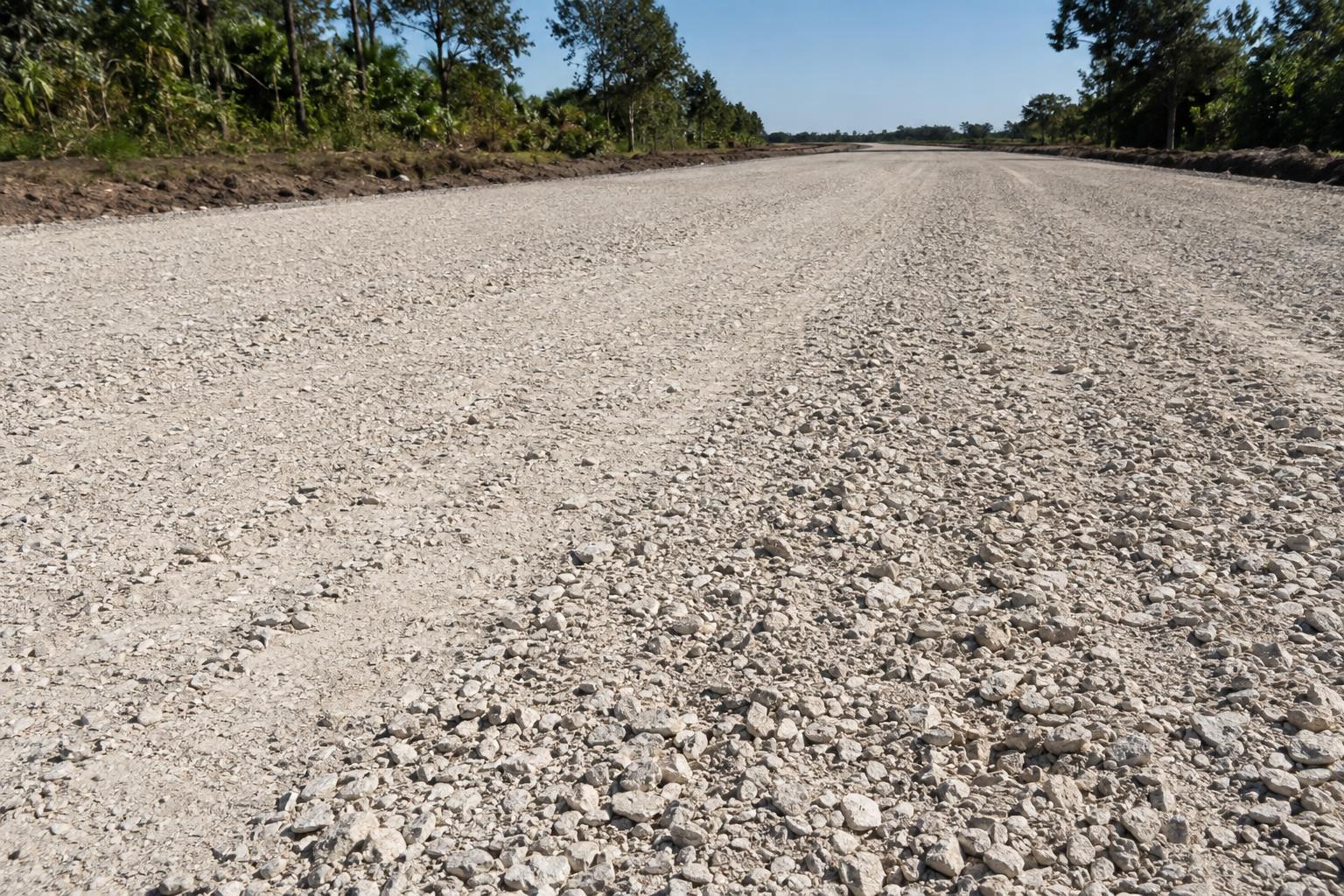
Crushed concrete
FDOT calls crushed concrete recycled concrete aggregate, or RCA, and defines it as material from crushing hard portland cement concrete. It has to be asbestos free, with caps on contaminants such as asphalt, brick, glass, wood and reinforcing steel. FDOT sets a higher strength bar for it than for limerock: an LBR of 150 for individual results. The specification also says not to use RCA base on interstate roadways, so check the typical section before assuming it’s allowed.
Graded aggregate
Section 204 covers graded aggregate base, a crushed and processed aggregate that must have an LBR of at least 100. The specification splits it into Group 1 (limestone, marble or dolomite) and Group 2 (granite, gneiss or quartzite) and allows only one group on a contract. It’s one of the options you’ll see beside rock in the optional base tables.
Stabilized subgrade: the layer under the base
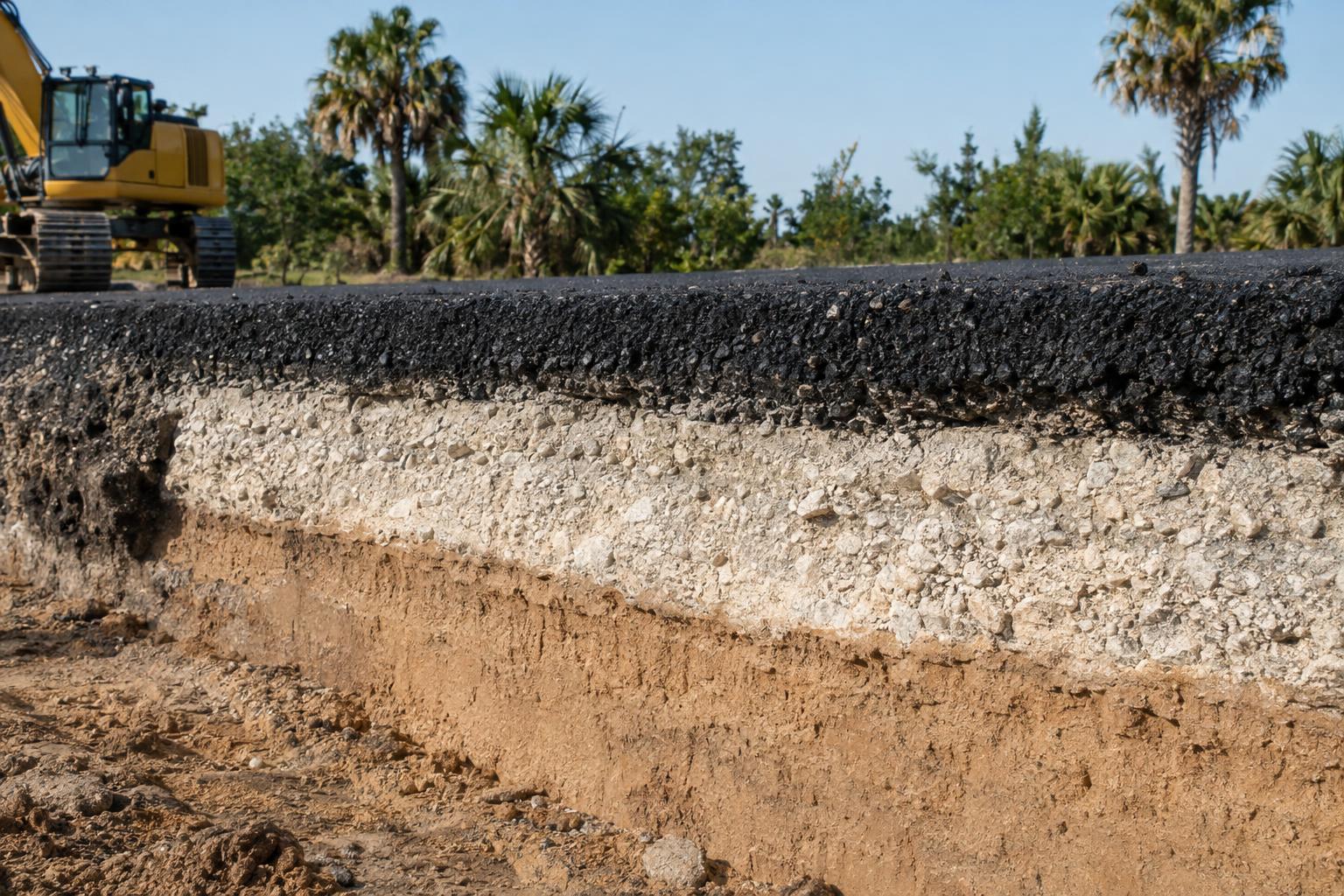
Base can only perform if the soil beneath it is firm. FDOT’s Section 160 describes stabilizing as treating designated portions of the roadbed to give a firm and unyielding subgrade with the bearing value the plans specify. Many Southwest Florida subgrades are sandy, so a stabilizing layer is a common line item on road plans.
The stabilizer can be commercial material (limerock, shell rock, cemented coquina or shell sources the department has approved) or local material, such as soils or recyclable materials like crushed concrete, provided they meet FDOT’s organic-content limits. Crews mix it through the full depth and width of the stabilized area, often with rotary tillers. One callout you may see is 12 inches of Type B stabilization requiring an LBR of 40, which FDOT ties to Standard Plans Index 120-001.
FDOT also keeps a short list of limited-use bases, such as limerock stabilized base at LBR 70. Those apply only when the plans specifically call for them, so a bidder shouldn’t substitute one for a standard rock option.
Placing, compacting and testing the base
Lifts and finishing
When the specified compacted thickness is more than 6 inches, FDOT requires multiple courses of equal thickness, and no course can be thinner than 3 inches. A contractor can propose lifts up to 8 inches, but only after a test section proves the compaction equipment reaches density through the full depth. Mechanical rock spreaders are the norm. Bulldozers or blade graders are allowed at crossovers, intersections and narrow areas where a spreader isn’t practical.
Contamination is a real cost driver. If subgrade gets mixed into the base, the specification says to dig out the mixture, reshape the subgrade and replace it with clean base at the contractor’s expense. Moisture matters too: if the rock isn’t at the right moisture content to reach density, it has to be wetted or dried, and in summer a rain event can stop base work for a day or more.
Density and thickness checks
For mainline lanes, turn lanes, ramps and parking lots, the specification requires at least 98 percent of modified Proctor maximum density, measured with a nuclear density gauge. Shoulder-only areas and shared use paths get a 95 percent minimum. Thickness is checked too: an area is deficient if the measured depth is more than a half inch under the specified thickness.
Surface irregularities greater than a quarter inch have to be corrected and recompacted. FDOT’s testing frequencies are in the specification, and your own contract documents say who performs the tests.
Prime coat
Where asphalt goes on rock base, Section 300 calls for a bituminous prime coat on the prepared base. That’s why Section 911 bars deleterious material that would keep the prime coat from adhering, such as clay balls, loose sand and free shells. A base that passes density but won’t take prime is still a problem.
What the base means for bids and schedules
Base work sits on the critical path of any road or parking area, and it touches more than the pavement. Sidewalks, shared use paths and shoulders sit on prepared base too, and FDOT’s Section 200 sets acceptance criteria for those areas. Our concrete work for sidewalks, curb and gutter and transitions depends on the same compacted foundation, so the base schedule drives the concrete schedule.
When you send a roadway package for pricing, the pages that shape our number are the typical sections, the geotechnical report, any LBR values and the stabilization depth. Also flag which base options the plans allow, who supplies density testing and whether the source must be an approved mine. Haul distance, material availability and the number of lifts all move the price, and the plans control all of it. Some local agencies adopt FDOT specifications and others use their own, so the contract documents decide which standard applies.
Base is one of the places where reading the plans carefully early saves rework later. If you’re assembling a package, our roadwork page lists what we typically want to see.
Frequently asked questions about road base materials
What is the base course of a road?
It’s the compacted layer between the subgrade and the pavement surface. On many Florida roads it’s rock base, such as limerock or cemented coquina, though plans can also specify graded aggregate, recycled concrete aggregate or an asphalt base. Its job is to spread load and keep water from weakening what’s below.
What are the different types of road base materials?
FDOT’s optional base list includes limerock, cemented coquina, shell rock, bank run shell, calcarenite, recycled concrete aggregate and graded aggregate base. Plans may also allow asphalt base or reclaimed asphalt pavement base. Each has its own strength, gradation and placement rules in the specifications.
Can crushed concrete be used as road base?
Yes, as recycled concrete aggregate, if the typical section allows it and the material meets FDOT’s composition and strength requirements. It must reach an LBR of 150 for individual results, and the specification prohibits it on interstates. Crushed concrete can also serve as a local stabilizing material under the right limits.
Can asphalt be laid directly on dirt?
Not on a road meant to carry traffic. FDOT lets crews place asphalt mix only on a surface that has been prepared, is firm, dry and clean. The plans show the layers and the bearing value each one must meet.
If the base section on your job is still an open question, the typical sections and geotechnical report are the best place to start. Call (239) 841-6400 or invite V&H to bid and send both with your plans.