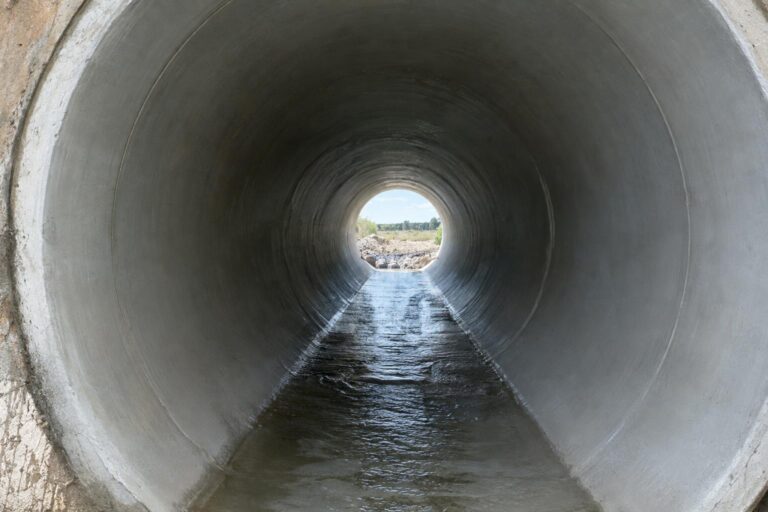
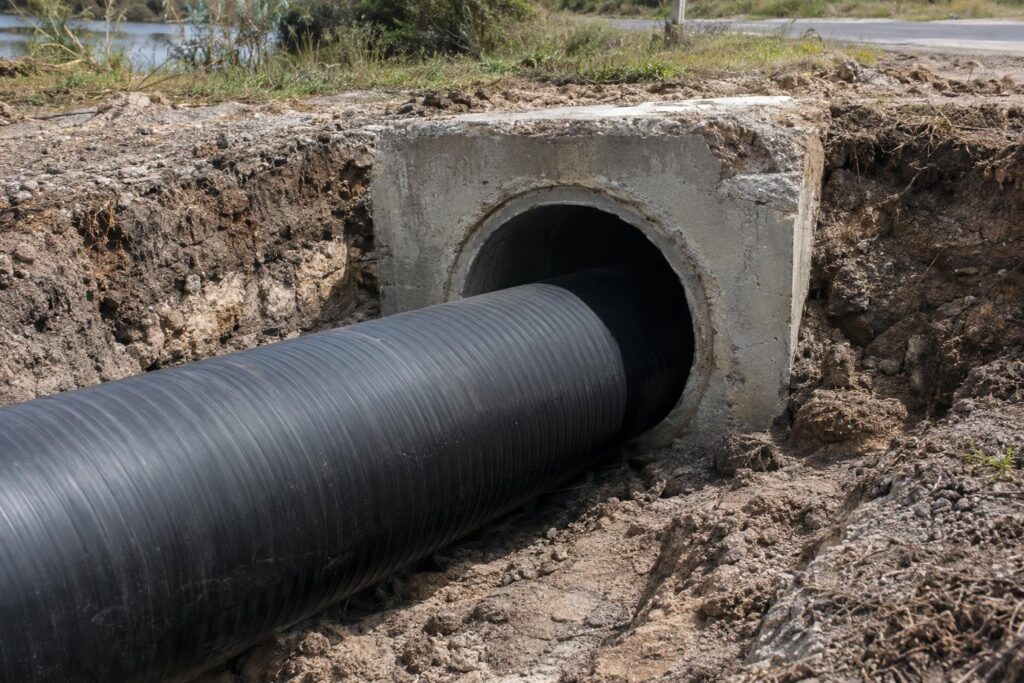
Slip lining pipe is one of the older trenchless fixes for a worn storm line: you push or pull a new, smaller pipe through the old one, then fill the gap between them with grout. The old pipe stays in the ground as a casing, and the new pipe does the work of carrying water. Public works staff and engineers use it on culverts and storm sewers that have corroded, cracked or lost joints but haven’t collapsed.
The trade-off is simple to state and easy to underestimate. The liner has to fit inside the old pipe, so the finished line is smaller than the one you started with. Here’s how the work goes, what that costs you in capacity and why the grouting step deserves its own line in the bid.
How Slip Lining Pipe Works, Pit to Pit
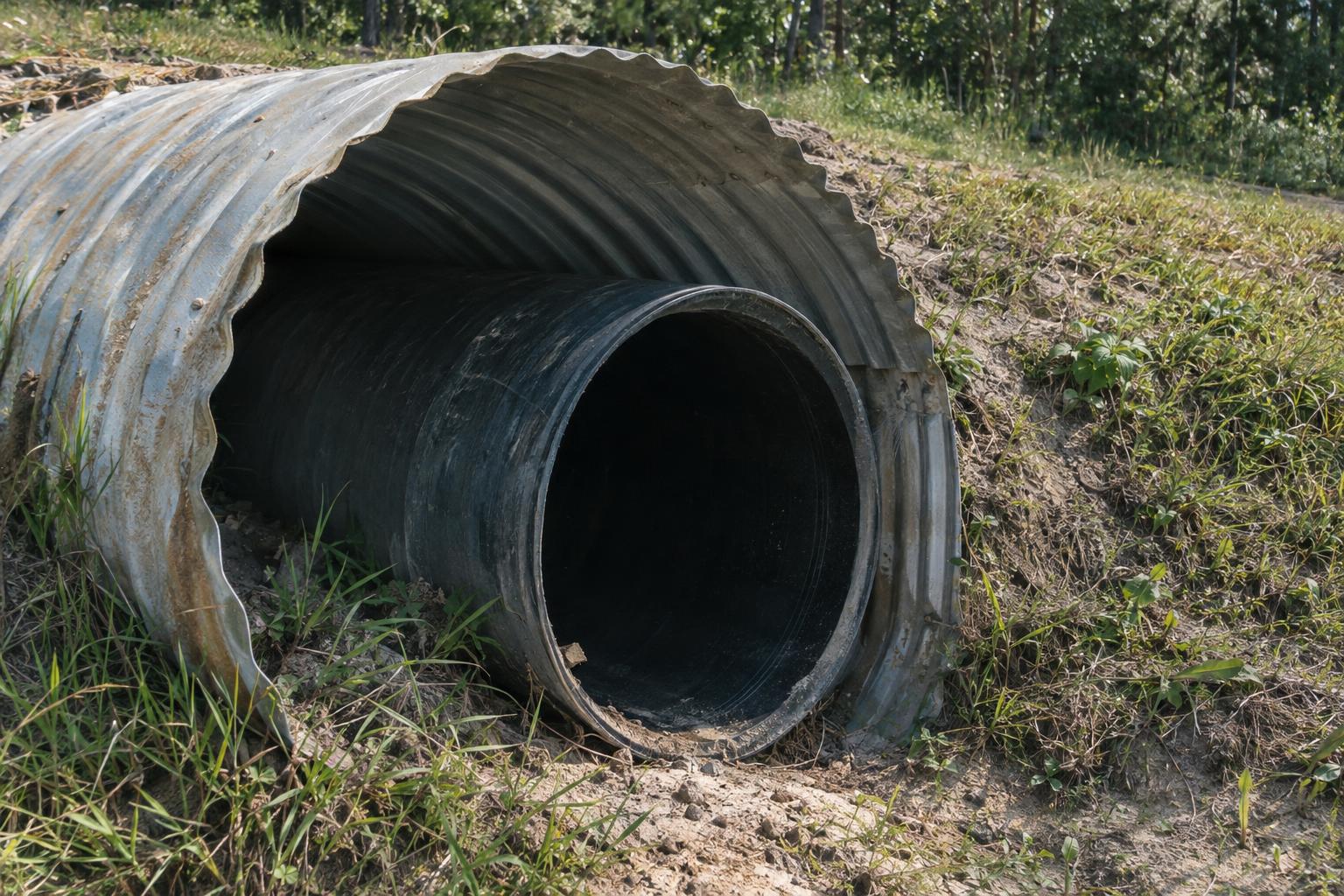
A slip lining job usually starts with an insertion pit at one end of the run, and a receiving point at the other. Florida DOT’s Section 431 describes the common arrangement: the crew joins discrete lengths, panels or segments of liner in a manhole or other access point and inserts them into the host pipe. In FDOT’s specification the liner can be polyethylene, high density polyethylene, polyvinyl chloride, fiberglass, steel or aluminum, with installation standards such as ASTM F585 for polyethylene and HDPE liner and ASTM F1698 for PVC; fiberglass, steel and aluminum follow the manufacturer’s instructions.
Before anything goes in, the host pipe gets prepared. FDOT’s specification requires the host pipe to be clean, dry and stable, with silt and debris removed, the pipe dewatered, cracks and joints sealed and flowable fill placed where the Engineer directs. A pipe that has already dropped or collapsed in one spot has to be excavated and repaired first, because a liner can’t be pulled through a blockage.
When the liner is pulled or pushed, loads on it are controlled. FDOT’s pulling and pushing method calls for protecting the liner end with a device that spreads the applied load around the perimeter, continuously monitoring that load and not stretching the liner by more than 1% of its original length. Once the liner is in, the ends aren’t sealed and grouting doesn’t start until 24 hours after installation. The full text is in FDOT’s FY 2026-27 Standard Specifications, Section 431.
Where it fits
Slip lining suits straight or gently curved runs between structures where the owner can accept a smaller flow area, such as a cross-road culvert with spare capacity. It is a poor choice for a line that is already hydraulically tight, or one with sharp bends or many connections that a stiff liner can’t negotiate. The engineer of record picks the method; the plans or specification state the liner type and the allowed alternates.
The Capacity Trade-Off in Numbers
A pipe’s flow area depends on the square of its diameter. That makes a small loss in diameter cost more than it sounds. As a hypothetical illustration, a liner with an inside diameter 10% smaller than the old pipe’s inside diameter carries about 19% less cross-sectional area, since 0.9 squared is 0.81. If the liner’s inside diameter is 30 inches in a 36-inch host, the area falls to roughly 69% of the original.
Several things make up that loss: the thickness of the liner wall, the annular space you need for grout and the clearance to get the liner in. Wall thickness depends on the loads the liner must carry, which is the liner designer’s job.
Two factors work the other way. A smooth plastic wall has less friction than corroded corrugated metal, so a smaller pipe can carry more per square inch of area than the rusty one it replaces. Improvements to the entrance geometry can also recover some capacity, according to the federal guide specification covered below. How that nets out for a given culvert is a hydraulic calculation, not a rule of thumb.
Agencies treat that calculation as required. The North Carolina DOT Pipe Liner Manual (March 2026), for example, requires hydraulic calculations comparing the existing culvert to the proposed liner. A federal guide specification for slip lining, UFGS 33 01 98, goes further for the gravity pipes in levees that it covers. It requires the liner to meet or exceed the host pipe’s conveyance capacity while keeping a minimum 1-inch annular space for systems that need grouting, unless an approved study allows reduced capacity. Your contract sets its own standard, and that line in the specification tells you whether capacity loss is allowed.
Annular Space Grouting
The annular space is the gap between the outside of the liner and the inside of the host pipe. FDOT’s Section 431 says to seal or grout it according to the liner manufacturer’s written instructions, and its payment clause makes sealing and grouting the annular space part of the pipe liner price.
The grout does several jobs. It locks the liner in place, stops soil and water from moving through the old pipe around the liner, and fills voids so the liner is supported evenly. The risk comes from the liner itself. Plastic pipe is light, and empty pipe in wet grout wants to float.
The federal specification spells out how to manage that, and it’s a useful picture of good practice even where your job uses a different document:
- Buoyancy plan
- The contractor submits buoyant force calculations and an estimated grout volume for each stage.
- Lifts
- Grout goes in as lifts, calculated beforehand, to avoid floating the liner and to keep the grout thickness uniform.
- Direction and venting
- Grouting runs downstream to upstream along the entire length. Vent holes at the crown and invert of the downstream bulkhead are plugged as grout begins to flow out.
- Pressure limit
- Gauged grout pressure at the pipe may not exceed the pipe manufacturer’s recommendation or 5 psi, whichever is less, in that specification.
- No hardened grout in the invert
- The liner must be clear of hardened grout after the work.
In Florida, groundwater often sits close to the surface, which adds to the buoyancy question. Ask how the plans want water managed in the annular space and inside the liner while the grout cures.
Planning the Insertion: Pits, Dewatering and Staging
Slip lining swaps a long trench for a pit, and the pit becomes the main earthwork item. It has to be big enough to hold or feed the liner, shored if the soil requires it and dewatered where the water table is high. We run the same shoring and dewatering discipline we used on a Burnt Store Road outfall rebuild, where the crew shored and dewatered the excavation before forming the headwall (see our project gallery).
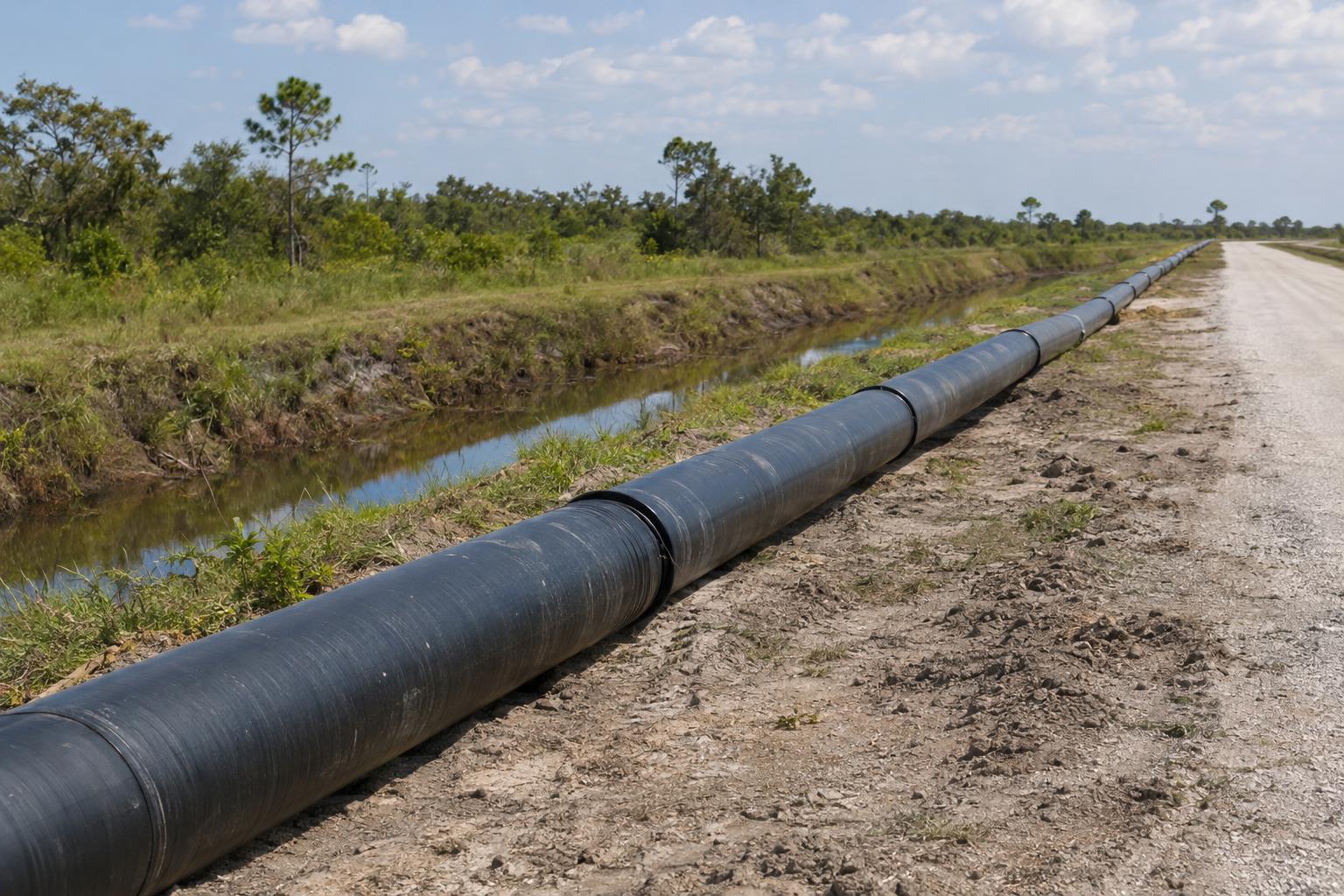
The other planning item is room for the liner. Some liner arrives in short lengths and goes in segment by segment from the pit. Other liner is laid out in a long string beside the run and pulled in as a unit, which needs clear ground in line with the pipe. Sketch that staging area on the access plan before you set the schedule.
Use this checklist when you read the bid documents:
- Insertion and receiving pit locations, sizes and restoration.
- Liner material, wall and inside diameter, and the specification that governs it.
- Required annular space and grout type, with who submits the buoyancy plan.
- Flow control: bypass pumping, plugging or work windows between storms.
- End treatment, including headwalls, bulkheads and any entrance improvements.
Our storm drain repair scope covers pipe lining, structure repair and outfall work, and the excavation and trenching behind it comes from the same crews who handle underground utilities and trenchless work on municipal lines.
Frequently asked questions about slip lining pipe
Does slip lining pipe reduce flow capacity?
Yes, the finished pipe has a smaller inside diameter, and the grout gap takes more room. A smooth liner wall recovers part of the loss, and the engineer’s hydraulic comparison shows whether the result is acceptable.
Is grouting always required?
Not always. A close-fit liner can make grouting unnecessary, according to the federal guide specification. For a conventional slip liner with a gap, FDOT’s Section 431 calls for sealing or grouting the annular space.
How does the liner get into a long run?
It depends on the liner. Segmental liner is joined in the pit or manhole and pushed in piece by piece, and continuous liner is pulled through as a string. The specification names the allowed methods and the load limits during insertion.
How long should the liner wait before grouting?
FDOT’s pulling and pushing method says not to seal the liner ends or begin grouting until 24 hours after installation. Other specifications set their own waiting period, so follow the one in your contract.
Call (239) 841-6400 or invite V&H to bid with your plans and pipe data, and we’ll walk through the pit layout, liner size and grouting plan against what the drawings call for.